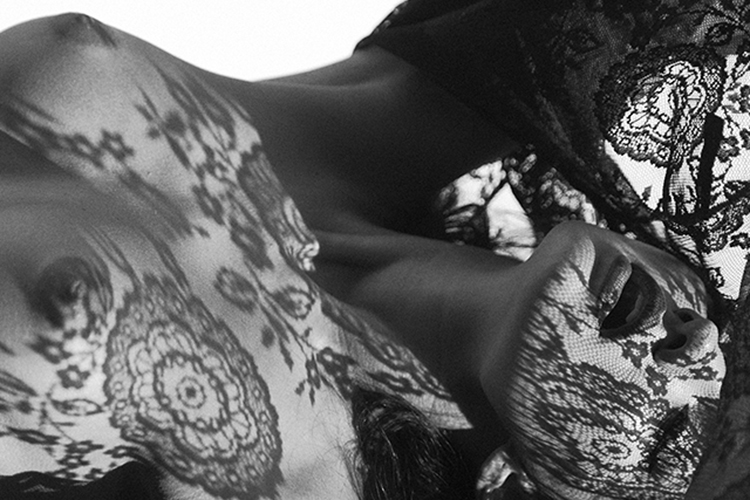

What makes a fine art print valuable? Buying a fine art print—a personal perspective on what sets photographic art apart from posters.
There are pictures that hang on the same wall for ten years. You walk past them every day, and at some point you stop noticing them. And then there are pictures that make you pause for a moment every morning. Not because they’re new—but because they have something that never loses its appeal.
I’m often asked why my prints cost what they do. It’s a valid question. And the answer has less to do with the price than with what goes into creating the image.


The paper is not a minor detail
I print on Hahnemühle FineArt paper. Not because it sounds good, but because I’ve seen the difference with my own eyes. A black-and-white image on regular photo paper looks flat. On Baryta or Photo Rag, it gains depth, contrast, and texture. The shadows are truly black. The highlights have texture.
Hahnemühle isn’t just a marketing slogan—it’s a long-established German company that has been manufacturing paper for over 450 years. Its FineArt papers are acid-free, age-resistant, and museum-quality. That means: The picture hanging on your wall today will look exactly the same in thirty years.
Limited availability is not a sales tactic
If I print and sign 199 copies of a design, that’s not artificial scarcity. It’s a decision about the value of the original. Once a design is out of print, it’s no longer available—neither from me nor anywhere else.
This has practical implications: Anyone who owns a low number owns something that no longer exists in that form. No reproduction, no reprint, and no digital version can replace it. This difference is real—and it grows over time, not smaller.
“Autographed” means: I was there
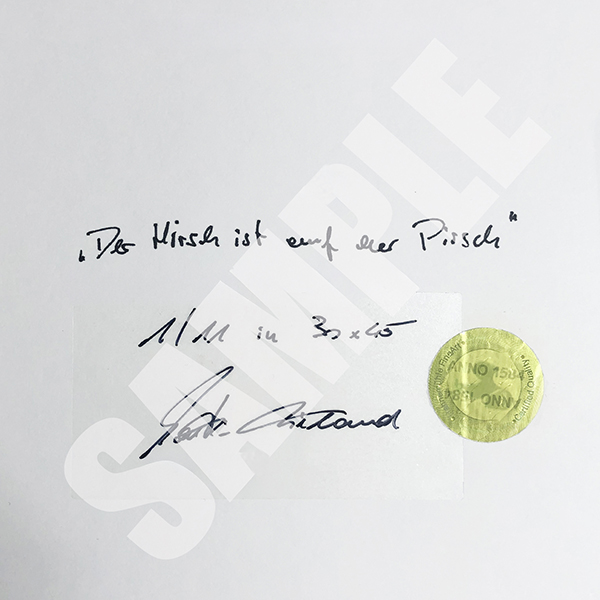
I sign each print myself—on the paper, with a pigment liner, directly below the image. Not printed, not stamped, not delegated. The signature is proof that this specific copy has passed through my hands.
That sounds like a minor detail. It isn’t. There’s a gap between an image that was printed somewhere and one that I’ve seen, reviewed, and signed—not a technical gap, but a human one.
A certificate is more than just a piece of paper
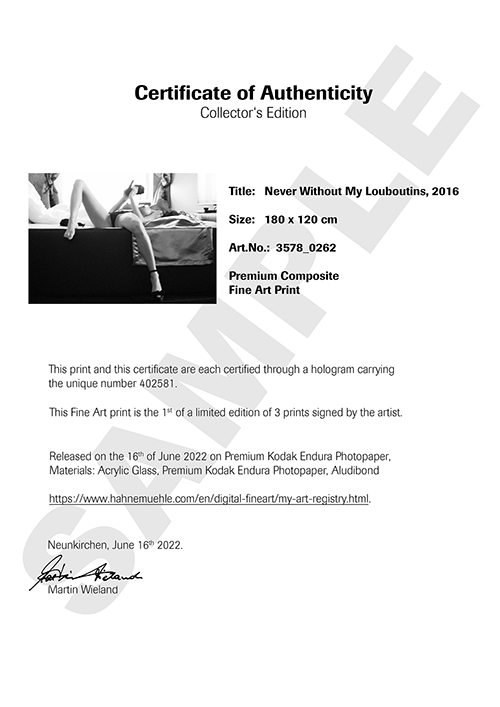
Every print in the Collector’s Edition comes with a certificate of authenticity: image, number, edition, date, signature. This is the documentation of the limited edition. It is proof that this image is indeed what it claims to be.
For collectors, this isn’t just an accessory—it’s the difference between an object with a history and one without.
Why this is relevant to you
You’re not buying a poster. You’re buying a work of art that cannot be replicated anywhere in the world. An image printed on a material that will outlast it. One that bears a unique number. One that is signed.
If you want to know what “fine art prints” mean in a physical sense, Hahnemühle provides a good overview: Printing, Protecting, Guaranteeing Authenticity
What you can collect:
SIGNED. FRAMED. ICONIC.
Framed, hand-signed, edition of 199 — available for four weeks, then gone.
👉 To the series
Collector’s Edition
Single works, strictly limited, with certificate of authenticity.
👉 To the Collector’s Edition
The Book & An Other Book
, 336 pages, 29×36 cm — not a “best-of” collection, but a cross-section.
👉 To the book bundle
Nude Calendar
Two versions, large format, hand-signed, limited edition.
👉 View the calendars
Nude Photography
How I work, where the images come from.
👉 To Nude Photography